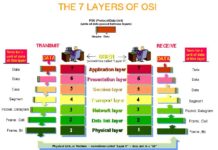

The SONET Model

***Level 3 uses “span” (same as Line) and “segment” (same as Section)
The Equipment at the Endpoints
(SONET Transmit and Receive Boxes)
SONET transmitter - a Layer 1 device - it takes data from Layer 2 and “Frames it into SONET frames” at Layer 1.
SONET receiver - also a Layer 1 device - it takes SONET frames from the “Layer 0” medium (the fiber), strips off the headers, and hands the payload (which are called frames for FR, Cells for ATM, etc) up to the Layer 2 (Data Link) processing hardware/software.
Example - the Xelic STS-3/STM-1 Framer Chip
This is an ASIC (Applications Specific Integrated Chip) that they call a “Network Core”. A router or switch could use one of these to prepare frames for transmission and to receive frames.
Transmitter and Receiver - full duplex operation combines transmit and receive functions with configurations for bypass, streaming, and mapping modes of operation at a data rate of 155Mb/s.
Transmitter - the XCS3
transmitter performs B1/B2/B3 parity calculations and insertions,
scrambling, and the insertion of transport and path overhead from an external
overhead port or through internal register programming.
Receiver - the XCS3 receiver byte aligns incoming data, de-scrambles appropriate frame byte locations, performs pointer processing for contiguous concatenated payloads, detects error conditions, accumulates various condition counts, and extracts transport and path overhead information to both internal register locations and external overhead ports.
Monitoring - a standard processor interface is provided for internal register configuration and the reporting of status, interrupt, and performance monitoring information.
Testing - various test modes are available for diagnostic purposes to transport fixed value payload information, force selected error conditions, and corrupt data to verify various interpreter algorithms and error counter operations.
Features
Complies with GR-253-CORE, ITU-T G.707, G.783, and ANSI T1.105 standards
Flexible core architecture includes variable size data bus widths of 8 to 32 bits
Supports transmit and receive facility and terminal loopback configurations
Accepts streaming SONET/SDH frames or mapped client signals for transport
Flexible insertion and extraction of transport and path overhead byte information
Programmable general purpose registers available for the insertion and extraction of any frame transport or path overhead location
Data corruption available through internal register programming for debug or test purposes
Performs SONET/SDH frame alignment with LOS and LOA detection
Programmable detection of LOF and OOF error conditions
Generates line AIS SONET/SDH frames for LOS and/or LOF error conditions
Supports scrambling/descrambling (1+x6+x7) with polynomial corruption capability for diagnostics
Programmable counters for user defined interval or errored second accumulation
Detects and accumulates B1/B2/B3 parity, path REI, and line REI error conditions in configurable bit or block error counters
Detects APS conditions (including line AIS and line RDI) and implements programmable acceptance count criteria
Provides insertion and extraction of section trace (J0) messages for 16 or 64 byte lengths and optional legacy J0/Z0 support
Provides insertion and extraction of path trace (J1) messaging
Detects path RDI and path REI error conditions
Detects LOP, Path AIS, and concatenation error conditions
Internal counters to track pointer increments and decrements
Generates frame start, SPE valid, SPE start, and transport/path overhead port control signals