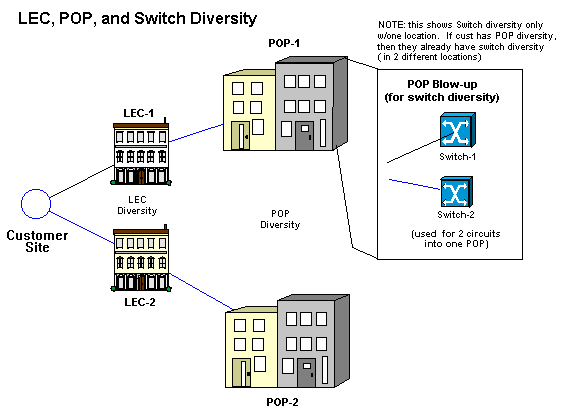

It is difficult to distinguish between these two concepts. Diversity is for two circuitsfrom the provider that use two diverse paths (diversity fees only apply to the second path). In contrast, avoidance is for one circuitwhich must “avoid” a path – typically one that is currently in place from a competitor’s circuit but can also be a LEC they want to avoid.
Diversity
Diversity involves two access circuits, where the customer wants the second circuit to take a different, unique path (or route). There are always two circuits, but they do not have to be ordered simultaneously. The diversity charges only apply to the second one. The customer can order both circuits at the same time or at different times. For example, one circuit could be ordered. Then a second circuit could be ordered a year later with diversity from the first circuit. All diversity orders require an SCA.

Avoidance
Avoidance is a rarely requested feature, which is priced in the same way that diversity is priced. Unlike diversity – it only applies to one circuit!! This will be a path which the customer does not want to take. This path is usually an existing circuit from a competitor. Still, it can also be a request to avoid a specific LEC that they have had problems with in the past. For example, the customer’s location may be served by two different LECs. It may have the possibility of being home to two different POP’s. The customer could then order a circuit to avoid one of the LEC’s and one of the POP’s.
Two Types of Diversity on the FTS2001 Contract
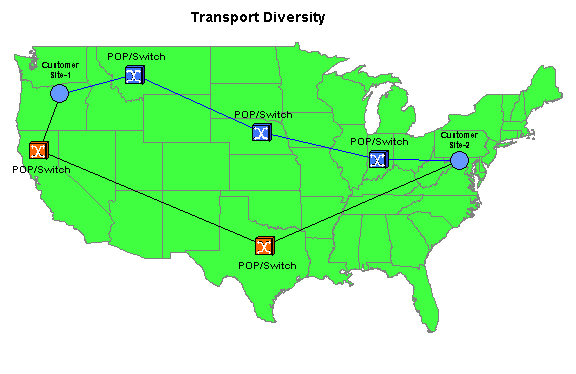
Although there are many types of diversity (LEC, POP, Switch, Transport, and combinations of the various types), there are just two different types of diversity on the contract. See diagrams on the next page. Usually, only the first (access diversity) applies, resulting in one fee, with three components rolled into that one fee, and one product code:
- Access diversity (this is the most common type ordered – it is a combination of LEC, POP, and Switch – but the order is usually for just POP diversity). Although on the same product code, the charges vary (the first digits vary depending on the type of diversity (ATM, FR, IP, DTS, etc. ), but it always ends with 0073). Special pricing charges resulting from the SCA are rolled up into this code and added to the contract’s basic fee for this code.
- Transport diversity (rare, and only for DTS) – diverse paths across the entire provider’s backbone. This is very expensive for T3 speeds.