
IEEE 802 Standards
The 802 standards comprise a huge family, of which Ethernet is one part of (802.3). Ethernet encompasses just one part that family . . . the 802.3 standards. Since there is an entire standard devoted to LLC (802.2), the 802.3 standard is depicted as stopping at the MAC sub-layer, and not going any higher. However, the supplements of 802.3 (802.3a, 802.3c, etc) often loosely include references and even detailed descriptions of the LLC.
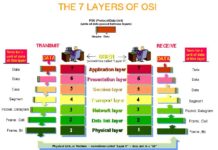
The most difficult part of understanding the Ethernet standards, is that they broke down the OSI model layer 2 (the DataLink layer) into two sublayers - LLC (Logical Link Control) and MAC (Media Access Control). Normally the DataLink layer is one set of protocols that describe both logical and physical properties of "how the data is sent & received on the cable". But in this case, since CSMA/CD was such a revolutionary concept, it was decided to break that out into it's own separate sub-layer, MAC.
IMPORTANT: newer Ethernet Networks use switches, which separate every station out into it's own segment, which is it's own collision domain. There are still two stations on each segment (the switch port and the computer) which seems to present a true collision domain - and if they used half-duplex there would still be collisions and CSMA/CD and a MAC layer would still be needed. But they use 2 pairs of cables with full-duplex - eliminating the need for both CSMA/CD and the MAC layer !!
| IEEE Standard |
Name | Description |
| 802.1 | Hardware-level Network Management | It includes the spanning tree algorithm for Ethernet MAC-layer bridges and the Heterogeneous LAN Management (HLM) specification for managing Ethernet and Token Ring wiring hubs. |
| 802.2 | Logical Link Control (LLC) | defines services for the transmission of data between two stations at the data-link layer of the OSI model. |
| 802.3 | Carrier Sense Multiple Access/Collision Detection (CSMA/CD) | these are Ethernet networks operate at varying speeds and over different cable types. See 1Base5, 10Base2, 10Base5, 10BaseF, and 100BaseT. |
| 802.4 | Token Bus | network access method. Token bus networks are sometimes used in manufacturing networks, but are rarely used in office-automation networks. |
| 802.5 | Token Ring | a logical ring network that uses a token passing access method. It comes in 4Mbits/sec and 16Mbits/sec speeds. It is physically wired in a star topology, with multistation access units, or hubs, as the center, to which workstations, servers, and other network devices are attached. Token Ring runs over shielded twisted-pair, unshielded twisted-pair, and fiber-optic cabling. |
| 802.6 | MAN (Metropolitan Area Network) | The MAN standard implements a distributed queue, dual-bus access method over a fiber-optic cable plant. Switched Multimegabit Data Services, an emerging high-speed WAN service, can run over a MAN physical network. |
| 802.7 | Broadband LANs | Broadband LANs (for example, 10BROAD36) Uses cable television-like components and use RF to transmit information in separate channels in a single cable. Broadband LANs are rarely used anymore. Do not confuse with Broadband ISDN or wideband networking. |
| 802.8 | Fiber-Optic Token Ring | this standard "was" for fiber-optic media used in token passing computer networks - like FDDI. Advisory Committee DISBANDED |
| 802.9 | Integrated digital and video networking | |
| 802.10 | Security | |
|
802.11 |
Wireless |
defines wireless networking. Encompasses many different methods of wireless transmission, including infrared and spread spectrum radio. Many data communications, computer, and telephone vendors are involved in the wireless LAN committee. |
|
802.12 |
Demand Priority Access |
HP's "100VG AnyLAN" |
|
802.13 |
Not Used |
|
|
802.14 |
Cable Modems |
|
|
802.15 |
Wireless Personal Area Networks |
|
|
802.16 |
Broadband Wireless Metropolitan Area Networks |
|
|
802.17 |
Resilient packet ring |